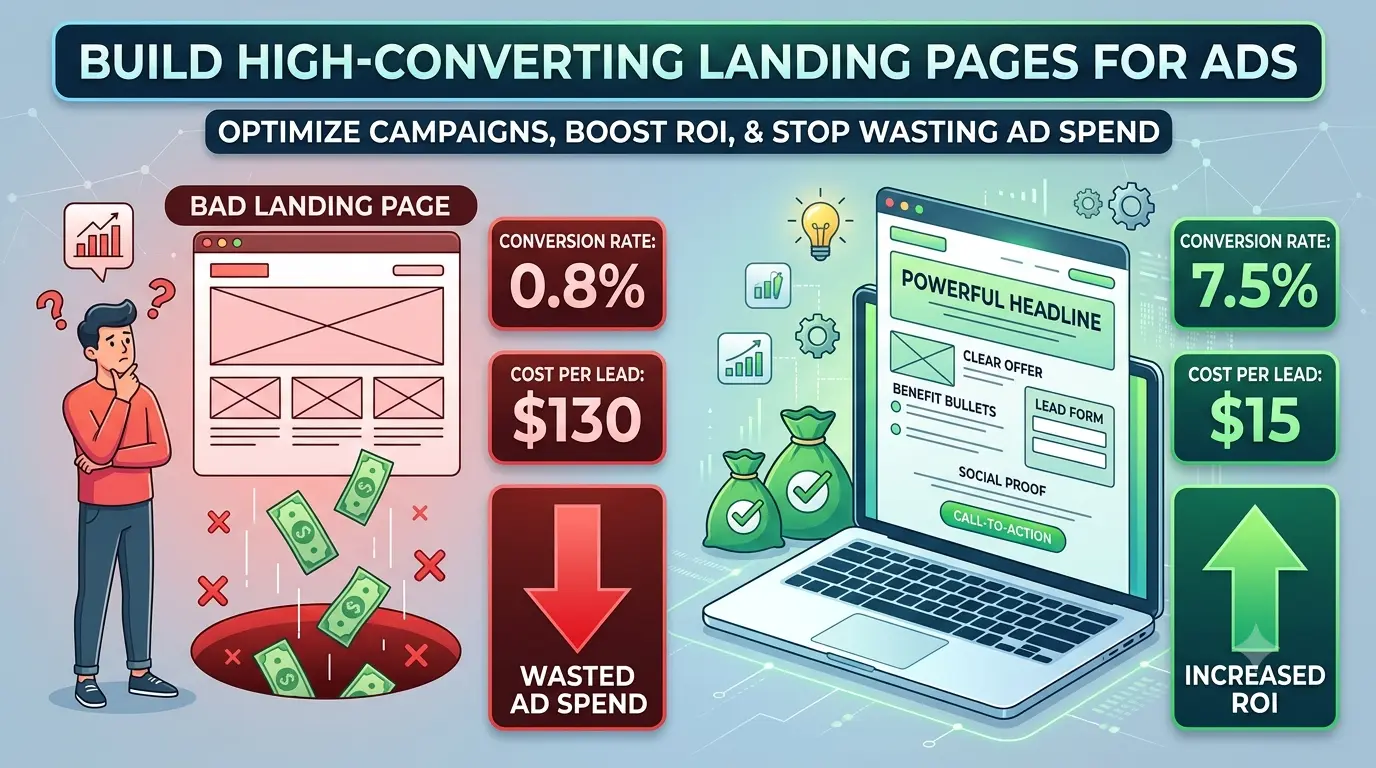
Most ad campaigns do not fail in the ad account. They fail on the page after the click. A business can write great ads, target the right keywords, and set smart bids, then send that expensive traffic to a homepage that was never designed to convert it. The result shows up every month as clicks without clients.
This guide from Seven Seas Web Design explains how to build a high converting landing page for your ad campaigns, and it starts in a place most articles skip: the math. We will work out the conversion rate your page actually needs before touching design, then build the page section by section with real examples from the kinds of Chicago and Lake County businesses we build pages for. If you run Google Ads or Meta Ads and the leads do not match the spend, the answer is almost always on this page.
To build a high converting landing page, dedicate one page to one ad group, mirror the ad’s exact promise in the headline, place a single call to action above the fold, stack local proof, keep forms to three fields or fewer, and load in under three seconds. Pages built this way regularly double the 6.6 percent median conversion rate.
What Is a High Converting Landing Page and How Is It Different From Your Website?
A high converting landing page is a standalone page built for one ad campaign, one audience, and one action. Unlike a homepage, it has no navigation menu, no competing links, and no general information. Every element exists to move a visitor from the ad click to a single conversion goal, usually a call, a form, or a booking.
The difference between a landing page and a website page is focus. Your homepage serves every possible visitor: job applicants, existing customers, researchers, and buyers. A landing page serves exactly one visitor, the person who just clicked your ad, and gives that person exactly one thing to do. That is why the landing page vs homepage decision matters so much for paid traffic. Unbounce’s Conversion Benchmark Report, built from 464 million visits to 41,000 landing pages, puts the median landing page at a 6.6 percent conversion rate, while homepages receiving ad traffic commonly convert at 1 to 2 percent. Same ad spend, three to six times the leads.
Do the Conversion Math Before You Design Anything
Here is the part almost every landing page article skips. Before you write a headline or pick a layout, you should know the exact conversion rate your page needs to hit for the campaign to make money. It takes three numbers: your cost per click, your average customer value, and the share of leads you close.
The formula works backward from profit. Decide the most you can pay for a lead, then divide your cost per click by that number to get your required conversion rate.
| Input | Example: HVAC Company in Gurnee | Where It Comes From |
|---|---|---|
| Average job value | $1,500 | Your books |
| Lead to customer close rate | 40% | Your sales history |
| Value per lead | $600 | $1,500 x 0.40 |
| Maximum you can pay per lead | $150 (keeping 4:1 return) | $600 divided by 4 |
| Cost per click on “furnace repair gurnee” | $4.50 | Google Ads |
| Required conversion rate | 3% | $4.50 divided by $150 |
Now the stakes are visible. At a 1 percent conversion rate, which is typical for homepage traffic, this HVAC company pays $450 per lead and loses money on every click. At 3 percent it breaks its target. At the 8.5 percent that well-built home services landing pages average, the lead costs $53 and the campaign prints money. Nothing about the ads changed. Only the page did. Run this math for your own business before spending another dollar, and if the required rate comes out above 10 percent, your problem is the offer or the cost per click, not the page design.
How to Build a High Converting Landing Page: 8 Steps
- Give every ad group its own pageOne page per offer, per audience. If you run ads for “furnace repair” and “AC installation,” those are two different visitors with two different problems, and they need two different pages. Sending both to one generic “HVAC services” page forces the page to speak vaguely to everyone, and vague pages do not convert.
- Mirror the ad promise in the headlineThis is message match, and it is the single highest-leverage element on the page. If the ad says “Same Day Furnace Repair in Gurnee,” the headline must say the same thing in nearly the same words. Unbounce research found strong message match converts at 2.5 to 3 times the rate of weak match. The visitor should never wonder whether they landed in the right place.
- Put the offer and one call to action above the foldHeadline, one supporting sentence, a phone number, and one button, all visible before scrolling on a phone. One goal per page. Every additional choice, including your own navigation menu, lowers conversion. Remove the menu entirely.
- Stack proof the visitor recognizesGeneric five-star graphics do nothing. Named local proof does: “437 furnaces repaired in Lake County since 2019,” a review that mentions Waukegan by name, a photo of your actual crew, your Google rating pulled live. Local specificity is proof; polish is not.
- Cut the form to three fields or fewerName, phone, and one qualifying question. Every field you add is a tax on conversion. If sales needs more information, collect it on the follow-up call, not the form. For emergency services, make the phone number the primary action and the form the backup.
- Load in under three seconds on a phonePortent’s research found pages loading in one second convert at three times the rate of pages loading in five, and each extra second costs about 4.42 percent of conversions. Compress images, skip the slider, and test on a real phone over cellular data, not your office wifi.
- Design for the thumb, not the mouseMost ad clicks are mobile. The call button belongs in a sticky bar at the bottom of the screen where a thumb rests, forms need large tap targets, and click to call must be a working tel link, not a printed number.
- Wire up tracking before launch, then test one thing at a timeConversion tracking on the form and the call button, connected to your ad account, on day one. Then change one element per test, starting with the headline, because message match tests move numbers more than button colors ever will.
Message Match: Real Examples of Weak vs Strong
Message match is easier to see than to describe. Here are three ad-to-headline pairs, the kind we audit constantly at Seven Seas Web Design.
| The Ad Says | Weak Headline | Strong Headline |
|---|---|---|
| “Same Day Furnace Repair in Gurnee, Call Now” | “Welcome to Comfort Heating & Cooling” | “Same Day Furnace Repair in Gurnee. A Tech at Your Door Today.” |
| “Invisalign in Waukegan, $99/Month Payment Plans” | “Quality Family Dentistry for Over 20 Years” | “Invisalign in Waukegan from $99/Month. Free Consultation.” |
| “Kitchen Remodeling in Libertyville, Free 3D Design” | “Your Trusted Home Improvement Partner” | “Libertyville Kitchen Remodels with a Free 3D Design First” |
Notice what the weak headlines have in common: they are all true, professional, and completely disconnected from the ad. The visitor searched for something specific, clicked a specific promise, and got a brochure. The strong versions repeat the promise, add the city, and answer the visitor’s next question before it forms.
What About Meta Ads Traffic? Search and Social Need Different Pages
One nuance most landing page guides never mention: traffic temperature changes the page. A Google Ads click comes from someone actively searching for a solution right now, so the page can be short, direct, and built around the call to action. A Meta Ads click comes from someone who was scrolling Facebook or Instagram and got interrupted by your ad. That visitor is colder, has less context, and needs more convincing before acting.
In practice, that means Meta traffic usually deserves a longer page: the same message-matched headline, then a short problem section, the offer, more proof, and the call to action repeated two or three times down the page. Same principles, different depth. Running both platforms through one identical page is a quiet conversion leak, and it is one of the first things we check when a client’s Meta campaigns underperform their search campaigns.
Why Google Rewards a High Converting Landing Page With Cheaper Clicks
A better landing page does not just convert more visitors. It lowers what you pay for every click. Google Ads scores your landing page experience as part of Quality Score, which Google documents openly. Relevance between your keyword, your ad, and your page raises the score, and higher scores win better ad positions at lower cost per click. Industry analyses consistently find that a below average landing page experience can inflate cost per click by 25 to 50 percent against a competitor with identical bids.
This creates a compounding effect most advertisers never see. The same message match that triples conversion also raises Quality Score, which cuts cost per click, which lowers your cost per lead from both directions at once. In the HVAC example above, pairing an 8.5 percent conversion rate with a 20 percent cheaper click drops the lead cost from $450 to roughly $42. That is a tenfold difference produced entirely after the click.
Common Landing Page Mistakes That Waste Ad Spend
- Sending ad traffic to the homepage. The most expensive mistake in small business advertising. The homepage has twenty exits and no single goal.
- Keeping the navigation menu. Every menu item is an exit door you paid to open. Landing pages need a logo, a phone number, and nothing else in the header.
- Asking for the sale and the newsletter and the download. Three CTAs is zero CTAs. Decision paralysis is measurable and it is expensive.
- Seven-field forms. Budget, timeline, address, how did you hear about us. Each one costs you leads that a two-minute phone call would have gathered anyway.
- Launching without conversion tracking. If you cannot see which ads produce leads, you cannot cut the ones that do not, and the budget bleeds silently.
- Testing button colors before testing the headline. Micro-tests on a page with weak message match rearrange deck chairs. Fix the promise first.
Landing Pages for Chicago and Lake County Ad Campaigns
Local campaigns give a high converting landing page an extra gear that national advertisers cannot use: geography as proof. A visitor in Grayslake who sees “Serving Lake County since 2012,” a map of your service area, reviews that name their town, and a local phone number converts at a different rate than one who sees a generic national page. If your ads target Chicago, Waukegan, Gurnee, or Libertyville, the page should say so in the headline, the proof, and the schema markup underneath.
Local landing pages also work best when they are consistent with the rest of your local presence. The same name, address, and phone number as your Google Business Profile, the same service area, the same reviews. We cover that foundation in our guide to local SEO for Lake County small businesses, and the two strategies feed each other: the ads capture demand today while the SEO compounds for free clicks later. If you are still deciding what a proper site build costs before adding landing pages, our breakdown of how much a small business website costs in Chicago covers where landing pages fit in the budget.
And once pages are live, measure everything. Your ad platform shows clicks, but pairing it with Search Console and analytics shows the full path. If your business also earns traffic through social content, our walkthrough on connecting social media to Google Search Console closes another measurement blind spot. The businesses that win paid traffic in 2026 treat digital marketing as one system: ads, pages, tracking, and follow-up built to work together, which is exactly how our web design team in Chicago builds them.
Frequently Asked Questions
What is a good landing page conversion rate in 2026?
The median across industries is 6.6 percent according to Unbounce’s analysis of 464 million visits. Home services lead generation pages average around 8.5 percent, e-commerce sits near 3.1 percent, and anything above 10 percent puts you in the top tier. Benchmark against your industry, not the global average.
What makes a high converting landing page different from a normal web page?
Focus. A high converting landing page serves one ad campaign, one audience, and one action, with no navigation menu and no competing links. A normal web page serves many visitor types and many goals, which is exactly why it converts paid traffic poorly.
Should I send Google Ads traffic to my homepage?
No. Homepages typically convert ad traffic at 1 to 2 percent because they offer many exits and no single goal. A dedicated landing page with message match routinely converts three to six times better from the same ad spend, and it improves your Quality Score, which lowers your cost per click.
What is message match and why does it matter?
Message match means your landing page headline repeats the specific promise made in your ad, in nearly the same words. Unbounce research found pages with strong message match convert at 2.5 to 3 times the rate of pages with weak match. It is the highest-leverage element on the page.
How many fields should my landing page form have?
Three or fewer: name, phone, and one qualifying question. Every additional field lowers conversion. Collect the rest during the follow-up call. For urgent services like repairs, make the phone number the primary call to action instead of the form.
How fast does a landing page need to load?
Under three seconds on a phone over cellular data, and faster is measurably better. Research from Portent found one-second pages convert at three times the rate of five-second pages, with each extra second costing about 4.42 percent of conversions.
How much does a landing page cost to build?
A professionally built landing page in the Chicago area typically runs $800 to $2,500 depending on copywriting, tracking setup, and design depth. Compare that one-time cost against what a low conversion rate costs monthly: the HVAC example in this guide loses over $400 per lead by sending traffic to the wrong page.
Do landing pages help my Google Ads Quality Score?
Yes. Landing page experience is a documented Quality Score factor. A relevant, fast page that matches the ad raises your score, and higher scores earn better ad positions at lower cost per click, so a good page cuts your lead cost from two directions at once.
Stop Paying for Clicks That Never Become Clients
Seven Seas Web Design builds landing pages for Chicago and Lake County businesses that do the math first: your numbers, your close rate, your market. We will audit your current ad-to-page path for free and show you exactly where the leads are leaking. If the page is fine, we will tell you that too.