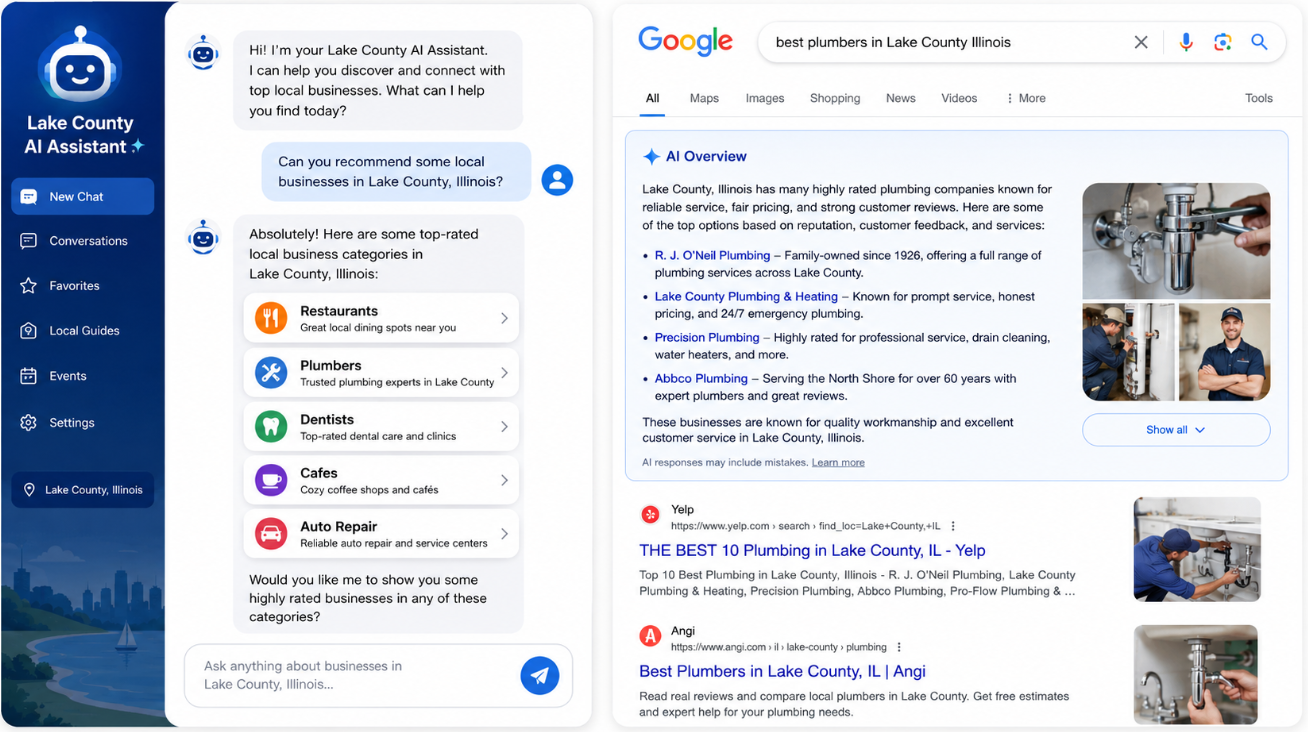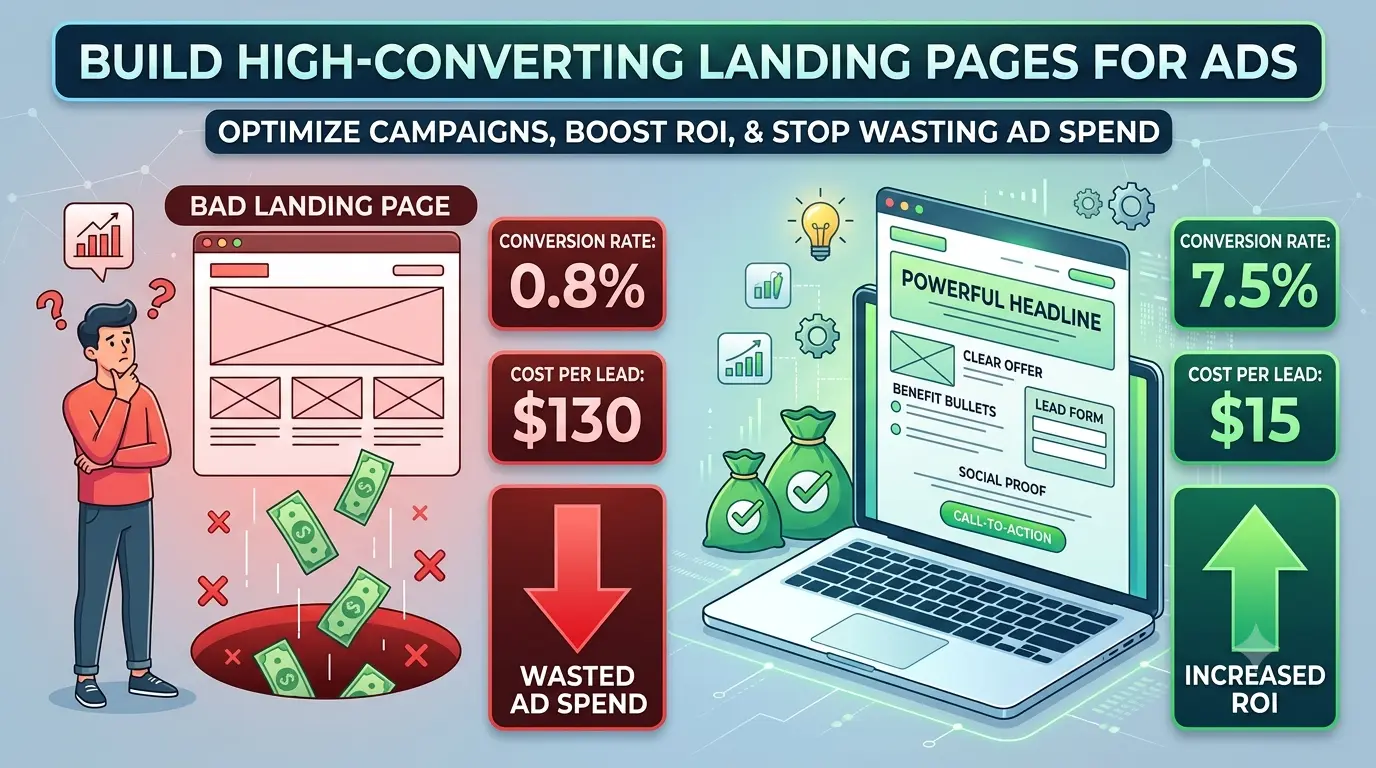
Most small businesses in Lake County have a Google Business Profile that is half-finished, a website that never mentions the city they serve, and a name that appears differently on every directory across the internet. None of this is intentional. Nobody sat down and decided to make their business invisible in local search. It just happened because no one explained how local search actually works or what it takes to show up. This guide does exactly that.
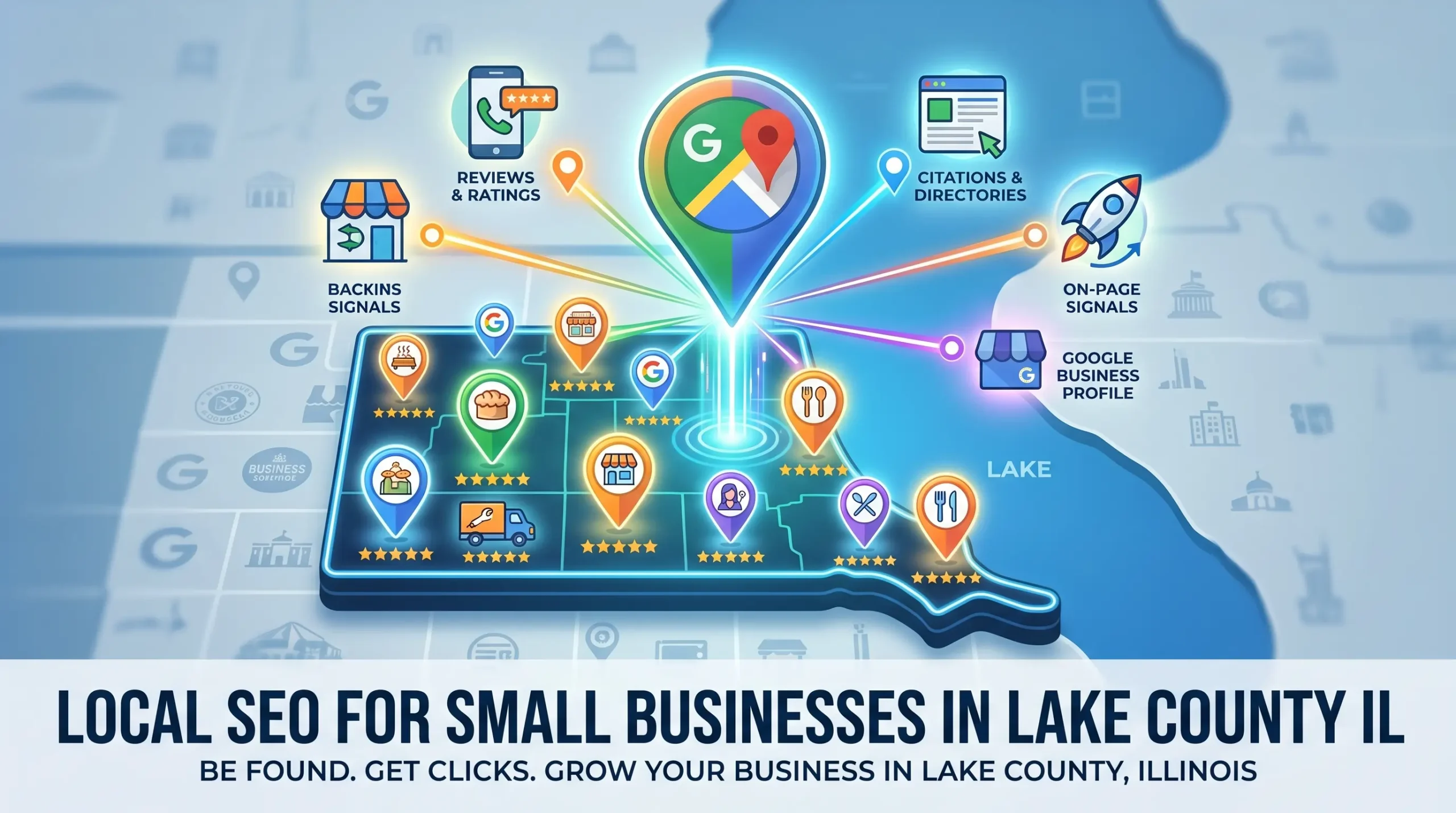
Local SEO for small businesses in Lake County IL is the process of optimizing your online presence so your business appears in search results when someone nearby looks for what you offer. When a homeowner in Gurnee searches “plumber near me” or a senior in Waukegan searches “breakfast restaurant open Wednesday,” local SEO determines which businesses show up first. It is different from general SEO because it targets geographic searches and relies on signals like your Google Business Profile, consistent business listings across the web, and location-specific content on your website.
Why Most Small Businesses in Lake County IL Struggle with Local SEO
Showing up in local search is not automatic. Google does not discover your business and decide to promote it because you have been operating for fifteen years. It needs specific signals before it will confidently recommend you to a nearby searcher. Most small businesses in Gurnee, Waukegan, Libertyville, and the surrounding towns are invisible not because their businesses are bad, but because those signals are missing or contradictory.
The five most common problems we see in Lake County small business profiles are: an unclaimed or incomplete Google Business Profile, inconsistent business name and address information across the web, a website with no local references, zero reviews or an abandoned review profile, and no local content that signals geographic relevance. Any one of these alone limits visibility. All five together makes a business effectively unfindable to anyone who does not already know its name.
Step 1: Your Google Business Profile Is the Foundation
Google Business Profile (formerly Google My Business) is the single highest-leverage action for local visibility. It is free. It directly controls what appears in Google Maps and the local three-pack. And most businesses treat it as a one-time form they filled out in 2019 and never touched again.
A fully optimized Google Business Profile for a Lake County small business looks like this:
- Business name matches exactly what appears on your storefront, invoices, and website. No keyword stuffing in the name field. Google penalizes it.
- Primary category is specific and accurate. “Restaurant” is too broad. “Mediterranean Restaurant” or “Breakfast Restaurant” is what wins local searches.
- Service area includes every city you actually serve: Gurnee, Waukegan, Libertyville, Grayslake, Mundelein, Vernon Hills, Lake Forest, Lincolnshire, Antioch, Round Lake, Zion, and North Chicago if applicable.
- Hours are accurate and updated for holidays and seasonal changes. A mismatch between your posted hours and your actual hours damages trust with both Google and customers.
- Description is written for customers, not for Google. It should explain who you serve, what makes you different, and where you are located. Use your city naturally.
- Photos are added regularly. Profiles with photos get 42% more direction requests. Add real photos of your space, product, or team at least once a month.
- Posts are active. Google Business Profile posts work like a social feed directly on your search listing. One post per week keeps your profile signaling activity to Google.
Step 2: NAP Consistency Keeps Google From Doubting You
NAP stands for Name, Address, and Phone number. It refers to how your business information appears across every website, directory, and platform on the internet. When Google sees your business listed as “Seven Seas Design” on one site, “7 Seas Web Design LLC” on another, and “Seven Seas Web Design, Inc.” on a third, it reads those as three different businesses and loses confidence in all of them. Consistent NAP signals to Google that your business is legitimate, stable, and worth ranking.
Every directory listing across the internet acts as a citation confirming your business exists at the location it claims. The more consistent citations Google finds, the more confident it becomes recommending your business to nearby searchers. For most Lake County small businesses, the priority directory list looks like this:
- Google Business Profile (primary, claims all search and Maps visibility)
- Bing Places for Business (often overlooked, still relevant for older demographics)
- Apple Maps (critical if your customers use iPhones, which most do)
- Yelp (especially important for restaurants, salons, and retail)
- Facebook Business Page (also functions as a citation even for businesses not active on Facebook)
- Better Business Bureau (strong domain authority, significant trust signal)
- Lake County Chamber of Commerce or local business association (geographic relevance signal)
- Industry-specific directories (Angi, Houzz, OpenTable, Zocdoc, Avvo, or similar depending on your trade)
Use the exact same business name, address format, and phone number on every single listing. If your address is “123 W Grand Ave, Suite 200, Gurnee, IL 60031” on your website, it needs to be identical everywhere. Abbreviations, suite number omissions, and phone number formatting inconsistencies all create signal confusion. Tools like Moz Local can scan your existing citations and flag inconsistencies across major directories.
Step 3: Your Website Needs Local Signals to Rank Locally
Having a Google Business Profile does not replace having a website with local signals. Both are required. Google uses your website to verify and reinforce what your Business Profile claims. A website that never mentions your city, your service area, or your state is a missed opportunity for every local keyword your potential customers are searching.
- City and state in your title tags. Every service page should have a title like “HVAC Repair in Libertyville IL | [Business Name]” rather than just “HVAC Repair Services.”
- Full address visible on every page, typically in the footer. This matches your NAP across the web and confirms your physical location to Google.
- Google Maps embed on your contact page. Embedding the map strengthens the geographic association between your website and your physical location.
- LocalBusiness schema markup in JSON-LD. This structured data tells search engines your business type, location, hours, and service area in a format they read directly from your site’s code.
- Service area mentioned naturally in body content. Writing “we serve homeowners throughout Gurnee, Waukegan, and Libertyville” reads naturally and sends a geographic signal Google picks up without keyword stuffing.
- Separate service pages for high-priority cities, if you serve multiple distinct markets. A dedicated “Web Design Waukegan” page ranks better for Waukegan searches than a general homepage ever will.
If your current website was built without any of these elements, a rebuild or strategic update from a web design team familiar with local SEO will be more effective than trying to patch a structurally weak site one item at a time. The foundation matters.
Step 4: Reviews Are a Ranking Factor, Not Just Social Proof
Google has confirmed that reviews affect local search rankings. Not just click-through rates, not just customer trust, but actual ranking position in the local pack. A business with 60 reviews averaging 4.6 stars will almost always outrank a competitor with 8 reviews averaging 4.9, assuming all other signals are similar. Volume, recency, and owner response rate all factor in.
The practical strategy for most Lake County small businesses is simple:
- Ask every satisfied customer within 48 hours of completing the transaction or service. This is when the experience is freshest and the likelihood of follow-through is highest.
- Send a direct link to your Google review page. Telling someone to “leave a review on Google” results in almost no action. Sending them a link they can click immediately results in reviews.
- Respond to every review, positive or negative. Google uses response rate as a signal of business engagement. A thoughtful response to a negative review also tells future customers more about your business than the complaint itself did.
- Never purchase, incentivize, or fabricate reviews. Google’s detection systems flag unnatural velocity patterns. A burst of 30 reviews in one week from accounts with no prior history gets flagged and removed, and can trigger a profile suspension.
A realistic target for a Lake County small business: 4.0 or higher average rating, at least 20 reviews, with new reviews coming in consistently. That profile will outperform most local competitors who have never built an active review strategy.
Step 5: Local Content Builds Authority Over Time
Beyond your Business Profile and website structure, the content you publish over time signals to Google that you are an active, knowledgeable business rooted in the local community. This is a longer-term play but one that compounds in ways that profile optimization alone cannot.
Local content for a Lake County small business does not mean writing about local news. It means writing content that is genuinely useful to local customers and naturally references the area you serve. A plumber in Waukegan writing “What Causes Pipes to Freeze in Lake County Winters and How to Prevent It” is creating something useful for nearby homeowners that will rank for searches those homeowners actually make. A restaurant in Gurnee writing about seasonal menu changes in the context of local events creates content that local food searchers will find and share.
Two to four pieces of local content per year is enough for most small businesses to build meaningful topical and geographic authority over an 18-month horizon. The businesses in Lake County consistently outranking their competitors in Google Maps are almost always the ones that have been publishing locally-relevant content alongside their profile optimization, not instead of it.
What to Realistically Expect from Local SEO in Lake County
Local SEO is not a switch you flip. It is a compounding investment that builds over months. The timeline below reflects what most Lake County small businesses experience when they implement all five steps outlined in this guide, starting from a baseline of minimal local presence.
| What You Implement | When to Expect Movement |
|---|---|
| Google Business Profile fully completed | 4 to 8 weeks for profile to gain traction |
| NAP citations across 20 or more directories | 8 to 12 weeks for citation signals to consolidate |
| On-page local signals added to your website | 6 to 10 weeks after a Google recrawl of your site |
| Active review acquisition (20 or more reviews) | 3 to 6 months of consistent outreach |
| Local content published regularly | 6 to 12 months for compounding authority |
| Competitive local pack ranking in a tough category | 4 to 9 months when all signals are in place |
Businesses in low-competition categories in smaller Lake County towns like Grayslake or Antioch often see meaningful local pack movement in 60 to 90 days. Businesses competing in high-volume categories like plumbing or HVAC in Waukegan should plan for a 6-month runway before expecting significant ranking changes. Both are worth doing. The compounding nature of local SEO means that work done today keeps generating results for years.
Who This Guide Is For
Restaurant and Cafe Owners
If people cannot find you on Google Maps when they search “breakfast near Gurnee” or “restaurant Waukegan,” you are handing those customers to whoever did take local SEO seriously.
Home Service Contractors
Plumbers, electricians, HVAC companies, and landscapers live or die by local search. If you are not in the top three on Google Maps, you are not getting the call. Read our full guide on contractor websites that generate leads.
Retail and Specialty Shops
People search for local retail before they drive anywhere. A complete Google Business Profile with photos, hours, and reviews is the difference between being found and being skipped entirely for a competitor with better visibility.
Professional Services
Accountants, attorneys, dentists, chiropractors, and insurance agents in Lake County compete in categories where trust signals like reviews and a strong online presence directly influence whether someone calls you or the next name on the list.
Frequently Asked Questions
How long does local SEO take to work for a Lake County small business?
Google Business Profile optimization typically shows results within 4 to 8 weeks. Full local pack ranking for competitive categories takes 4 to 9 months when all signals are implemented correctly. Low-competition categories in smaller Lake County towns often move faster, sometimes within 60 to 90 days.
Do I need a website to do local SEO?
You can make partial progress with a Google Business Profile alone, but a website dramatically strengthens every local signal. Google uses your website to verify what your Business Profile claims, and on-page local signals like city-specific title tags, schema markup, and service area content meaningfully improve how high you rank. Businesses with optimized websites consistently outrank those with only a Business Profile in competitive searches.
What is the local pack or map pack?
The local pack is the block of three business listings that appears at the top of Google search results when someone makes a local search. It shows a map and three businesses with their name, rating, address, and phone number. Appearing in the local pack for your category is the primary goal of local SEO, because those three listings get the majority of clicks from people searching for a local business.
How many citations does my business need?
There is no magic number, but most local SEO practitioners aim for 20 to 50 consistent, high-quality citations before the returns diminish significantly. Priority should go to the major platforms first: Google, Apple Maps, Bing Places, Yelp, Facebook, and BBB. Industry-specific directories and local Chamber of Commerce listings add meaningful geographic relevance signals on top of that foundation.
Does my business address have to be physically in Lake County to rank for Lake County searches?
For Google Maps and the local pack, Google strongly favors businesses with a physical address inside the search area. Service-area businesses without a storefront can still rank for nearby searches, but a verified physical location in Lake County will consistently outperform a competitor located in Chicago or another county targeting the same geography. If you have a physical location in Lake County, make sure it is verified and fully optimized.
Is Google Business Profile really free?
Yes. Google Business Profile is completely free to claim, verify, and maintain. There are paid advertising products built on top of it, like Google Local Services Ads, but the core profile that controls your Maps and local pack visibility costs nothing. The investment is time, not money, which is what makes it the highest-leverage starting point for any Lake County small business working with a limited marketing budget.
Your Competitors Are Already Doing This
If your business is not showing up in local search for Gurnee, Waukegan, Libertyville, or the surrounding Lake County area, the businesses ranking above you did not get there by accident. Seven Seas Web Design builds websites with local SEO built in from day one, not bolted on afterward. Start with a free consultation.