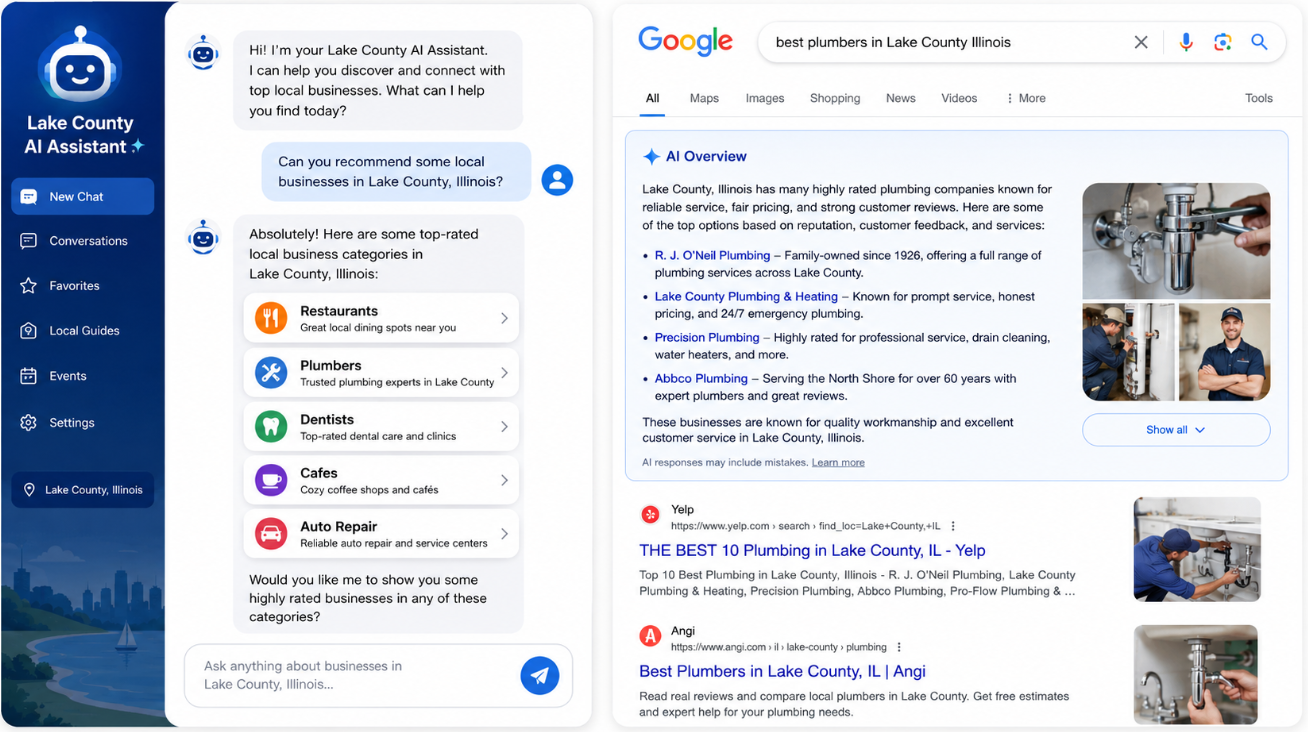
Short answer: Open ChatGPT, ask it to recommend a business like yours in your town, and see whether your name appears. If it does not, AI search engines either do not know you exist or do not trust the information they hold about you. The five-test check below takes ten minutes, gives you a score out of 10, and tells you exactly which of the five fixes your result points to.
At Seven Seas Web Design we run this exact diagnostic as the opening step of every audit, and the pattern across Lake County businesses is consistent: most score between 3 and 6. That is not a disaster. It means the business is real, the reputation is real, and the machine-readable layer that AI engines depend on was simply never built.
This guide is the test itself, written so a business owner can run it without a developer. If you want the strategy behind why this shift happened, read our breakdown of zero-click AI search and how Lake County businesses win in 2026 first. If you already know the problem and want to measure your own exposure, start here.
Key Takeaways
- The behaviour has already changed. Industry reporting puts the share of consumers using tools like ChatGPT to find local businesses at roughly 45%, up from around 6% a year earlier (Local SEO & AEO Trends for 2026).
- Your rankings report will not warn you. You can hold position three in Google and be completely absent from the AI answer sitting above it. Nothing in your analytics flags this.
- The category test is the one that matters. Nobody types your business name into an AI assistant unless they already know you. Every genuinely new customer arrives through a category question.
- Wrong information is worse than no information. Old hours and dead phone numbers get quoted with total confidence, and the customer never tells you why they gave up.
- Most of the fix is structural, not creative. Google Business Profile completeness, plain factual statements, schema markup, answer-first formatting, and load speed. A rebuild is rarely required.
Why This Check Matters More Than Your Google Ranking
Something changed quietly over the past year in how people in Gurnee, Waukegan, Libertyville and the rest of Lake County find local businesses. They stopped scrolling through ten blue links. They started asking a question and taking the first answer they were given.
That shift creates a problem no ranking report will show you. Traditional SEO measures your position on a page. AI search does not produce a page of positions. It produces one answer, assembled from sources it decided to trust, and either you are in that answer or you are not. There is no second place, no page two, and no impression data telling you what you missed.
The practical consequence is a slow leak rather than a crash. Your rankings hold. Your traffic dips slightly and gets blamed on seasonality. The calls thin out. Six months later the pipeline is noticeably drier and nothing in your reporting explains it. We have watched this happen to well-run businesses with genuinely good websites, which is exactly why we now run this diagnostic before anything else.
Worth knowing before you start: this check measures visibility, not quality. A business with excellent reviews and twenty years of local reputation can still score 2 out of 10, because AI engines read structured data and clear factual statements, not goodwill. That gap is the opportunity — it is far easier to fix than a reputation problem.
The Free Tools You Need (All Links Included)
Everything in this check is free. You need four tabs open for the test itself, and there are five more tools worth bookmarking for the fixes afterwards. No paid subscription is required for any of it.
| Tool | What it tells you | Used in |
|---|---|---|
| ChatGPT | Whether the most widely used AI assistant knows your business, and whether it recommends you for your category | Tests 1, 2 and 5 |
| Perplexity | Which exact pages get cited as sources. The fastest way to see whether your own site is being quoted | Test 4 |
| Google (incognito) | Whether you appear in the AI Overview that sits above the map pack and organic results | Test 3 |
| Gemini and Microsoft Copilot | Second-opinion checks. Copilot matters if your customers use Windows or Edge defaults | Optional cross-check |
| Google Business Profile | What you actually published, so you can compare it against what AI is saying about you | Test 5 and Fix 1 |
| Google Rich Results Test | Whether your pages carry valid structured data, and which types Google can read | Fix 3 |
| Schema Markup Validator | Deeper schema errors that the Rich Results Test does not surface | Fix 3 |
| PageSpeed Insights | Real load times on mobile. Slow sites get sampled less thoroughly by crawlers | Fix 5 |
| Google Search Console | Whether your pages are indexed at all. Nothing downstream works if they are not | Diagnosis |
| BrightLocal Search Results Checker | What local results look like from your customers' location rather than yours | Optional |
Two setup notes that materially change your results. First, enable web search in ChatGPT so it pulls live information rather than answering from training data. Second, run every Google test in an incognito window while signed out, because your own search history will flatter the results and show you a version of the internet only you can see.
If you have never set up Search Console for your domain, do that first — our guide to connecting your properties to Google Search Console covers the verification steps.
The 10-Minute AI Visibility Self-Check
Five tests, two minutes each. Before you begin, write down three things and do not change them mid-test: your business name, your primary service, and your town. You will be tempted to reword the prompts until you get a better answer. Resist that. The point is to search the way a customer would, not the way an owner would.
Minutes 1 to 2: The direct name test
Paste this into ChatGPT, replacing the bracketed parts:
Tell me about [Your Business Name] in [Your Town], Illinois.
What services do they offer and what are they known for?
You are checking three things: does it know you exist, is the description accurate, and does it cite your website as a source rather than pulling from a directory listing somewhere else.
Pass — it describes your business correctly and references your own site. Partial — it knows you, but the details are thin, dated, or drawn entirely from Yelp and Facebook. Fail — it has never heard of you, or it confuses you with a different business.
A partial result is more common than owners expect, and it almost always means the same thing: your website is not the authoritative source about your own business, so something else has filled that gap.
Minutes 3 to 4: The category test
This is the test that actually matters, and the one most businesses fail. Run both prompts:
What are the best [your service] companies in [your town], Illinois?

I need [your service] in [your town] this week.
Who should I call and why?
The second phrasing matters because it is how people genuinely talk to an assistant. Nobody types your business name into ChatGPT unless they already know you. Every genuinely new customer arrives through a category question like this one.
Pass — you appear in the list, ideally in the first three. Partial — you appear only after a follow-up prompt, or well down a long list. Fail — competitors are named and you are not.
If you pass the name test but fail this one, you are visible only to people who were already going to find you. That is the single most common result we see, and it is the clearest signal that the problem is corroboration rather than content.
Minutes 5 to 6: The Google AI Overviews test
In an incognito window, search Google the way a customer would: best [service] in [town] IL. Look at the AI-generated summary at the top of the results — above the map pack, above the organic listings.
Check two things. Is your business named in that summary? Do any of the small source links attached to it point at your website?
Do this one carefully, because AI Overviews sit above everything else on the page. A first-position organic ranking underneath an AI summary that names three of your competitors is not the win it looks like in a rankings report. The customer has usually stopped reading by then.
Minutes 7 to 8: The Perplexity citation test
Ask Perplexity the same category question. Perplexity earns its place in this check because it lists its sources in plain view, so you can see precisely which pages it trusted enough to quote.
Look at where those citations point. Directory sites? A competitor's blog post? A chamber listing? A news article? Or actual business websites?
Pass — your website appears as a cited source. Partial — you are mentioned but the citation points elsewhere. Fail — neither your name nor your site appears.
If competitors' blog posts are being cited while your service pages are ignored, that is a content-structure problem rather than a visibility problem, and it is very fixable. Our guide to generative engine optimization for local business covers the structural side in depth.
Minutes 9 to 10: The accuracy test
What are the hours, phone number, address and services
offered by [Your Business Name] in [Your Town], Illinois?
Now check every detail against reality, with your Google Business Profile open in the next tab. Old address. Disconnected phone number. Hours from two years ago. A service you stopped offering. A service you never offered at all.
Wrong information is worse than no information. A customer who calls a dead number does not try again, and they do not tell you why they gave up. This test regularly surfaces the most embarrassing problems on the list, and it is also usually the fastest to fix.
Score Your Results
Give yourself 2 points for each pass, 1 for each partial, 0 for each fail. Maximum score is 10.
| Score | What it means | What to do next |
|---|---|---|
| 8–10 | AI engines know you, trust your site, and quote it. You are ahead of most Lake County businesses. | Protect the position. Keep information current and expand into question-based content. |
| 5–7 | You exist in the index but you are not the answer. Usually a structure and schema gap, not a content gap. | Start at Fix 3. Schema and answer formatting move this score fastest. |
| 2–4 | Visible only to people already searching your name. New customers are not finding you through AI. | Google Business Profile first, then site structure. In that order. |
| 0–1 | Functionally invisible to AI search. Every AI-assisted customer in your area is being handed to a competitor. | Treat as urgent. Get an audit before spending anything further on ads. |
What Each Failure Actually Means
The total score tells you how urgent this is. Which tests you failed tells you what to fix.
You failed the name test
AI engines hold no confident record of your business. This almost always traces back to one of three things: an incomplete or inconsistent Google Business Profile, a business name that varies across listings, or a website that never plainly states who you are, what you do, and where you do it. If your homepage headline reads something like "Quality You Can Trust" instead of naming your service and your town, a language model has nothing concrete to work with.
You failed the category test but passed the name test
The most common pattern by a wide margin. You are known but not recommended. AI engines choose recommendations based on corroboration — reviews, citations, directory listings, and structured data that all agree with each other. One well-built website on its own is not enough evidence. This is where consistent local SEO for Lake County small businesses does the heavy lifting.
Your information was wrong
Somewhere in the chain, an outdated source is being trusted over your own site. Old directory listings, a duplicate Google profile you forgot existed, an abandoned social account. AI engines average what they find across sources, so a single stale listing repeated in several places can outweigh the correct one.
You appeared but were not cited
Your content is being read but not quoted. This is a formatting problem, not a quality problem. AI engines quote passages that answer a question directly and sit under a clear heading. Long unbroken paragraphs of marketing copy that circle a point without landing on it get skipped, however well written they are.
What AI Engines Actually Read on Your Site
Understanding what these systems can and cannot see explains most surprising results in this check. AI engines are not browsing your website the way a customer does. They are extracting facts.
| Reads easily | Reads poorly or not at all |
|---|---|
| Plain text in headings and paragraphs | Text baked into images and graphics |
| Structured data (LocalBusiness, FAQ, Service) | Menus, price lists and specs published as PDFs |
| Clearly labelled contact and hours information | Details that live only inside a booking widget or iframe |
| Question-shaped headings with direct answers below | Marketing copy that never states a plain fact |
| Consistent name, address and phone across the web | Content that only renders after user interaction |
| Fast-loading pages that render quickly | Slow pages that time out before full rendering |
The right-hand column is where most Lake County businesses lose. A restaurant with a beautiful PDF menu, a contractor whose service area is only shown on a map graphic, a clinic whose insurance list sits inside a booking tool — all three are invisible for the exact questions their customers ask most.
The Five Fixes, In Order of Impact
Work through these in sequence. Each builds on the last, and doing them out of order wastes effort.
Fix 1: Complete your Google Business Profile properly
Not eighty percent complete. Every field: primary and secondary categories, full service list, service area, hours including holidays, attributes, and photos added regularly rather than once at setup. Google's own profile data is one of the strongest sources AI systems draw on for local answers, which makes this the highest-return hour you will spend on the entire list. Start at Google Business Profile.
Fix 2: Make your identity unmistakable on your own site
Your business name, your service, and your service area should appear in plain language in your title tag, your H1, and your first paragraph. Not implied — stated. A machine cannot infer that "serving the North Shore since 2009" means Lake County, Illinois. Write the sentence a customer would need if they had never heard of you.
Fix 3: Add complete schema markup
LocalBusiness schema carrying your name, address, phone, hours, service area and services, plus FAQ schema on any page that answers questions. This is the layer that converts your website from prose into structured facts a machine can quote with confidence. Google publishes the LocalBusiness structured data specification, and you can verify your implementation with the Rich Results Test.
Fix 4: Restructure content to answer questions directly
Use the actual customer question as a heading, then answer it in the first two sentences underneath. Detail follows after. This single formatting habit does more for AI citation than any amount of keyword work, and it happens to make the page easier for humans to read at the same time.
Fix 5: Fix your load speed
Crawlers, including those feeding AI systems, have limited patience. A site taking six seconds to render gets sampled less thoroughly than one rendering in two. Check yours with PageSpeed Insights on the mobile tab. We covered the business side of this in the real cost of ignoring web performance — the same technical debt costing you conversions is also costing you visibility.
One thing worth saying plainly: none of this replaces having an actual website. If you have been running your business on a Facebook page and a Google listing, AI engines have very little to work with and no authoritative source to cite. We laid out the full argument in do I really need a website if I already have social media pages, and AI search has made that case considerably stronger than it was two years ago.
Five Mistakes That Keep Businesses Invisible
These come up in nearly every audit we run, and each one is self-inflicted rather than competitive.
- Testing while signed in. Your own Google account personalises results around businesses you have already visited. Signed in, you look far more visible than you are. Always test incognito.
- Rewording the prompt until you appear. Adding your street name or a niche detail until the answer includes you proves nothing. Customers do not know those details — that is why they are asking.
- Treating a Facebook page as a website. Social platforms are weak citation sources for AI engines. They rarely get quoted as authoritative for facts about your business.
- Publishing key facts as images or PDFs. Menus, price lists, service areas and hours in graphic form are invisible. If it matters, it must exist as text on the page.
- Fixing it once and never checking again. AI engines re-crawl and re-average continuously. A profile that drifts out of date quietly reverses months of work.
What This Looks Like by Business Type
Home service contractors
Emergency and same-day questions dominate your category, and they arrive as full sentences: "who can fix a burst pipe in Waukegan tonight". Service-area pages, clear hours, and click-to-call above the fold matter more than a portfolio gallery. Our guide to contractor website design in Lake County IL goes deeper on the structure this needs.
Restaurants and cafes
Menus published as PDFs are effectively invisible to AI engines, and so are menus built entirely from images. If your dishes, prices and dietary options are not readable as text, you will not be recommended for the question that matters most, which is some version of "where can I eat near here that has X".
Medical and dental practices
Accuracy and trust signals carry disproportionate weight in health-related answers. Practitioner credentials, insurance accepted, and new-patient availability should be stated in text on the page, not buried inside a booking widget a crawler cannot read.
Retail and specialty shops
Product categories, brands carried, and parking or accessibility details are what get quoted. "Where can I buy X in Libertyville" is a question AI answers constantly, and it answers it from whichever pages state those facts most clearly.
Professional services
Law firms, accountants and consultants get filtered by specialism before anything else. Practice areas and the specific problems you solve need to be named explicitly. "Full-service firm" tells a machine nothing it can use to recommend you.
What to Expect After You Fix It
AI visibility does not improve overnight, and anyone promising otherwise is selling something. Realistic timelines, based on the recovery pattern we see across client work:
| Change made | Typical time to show up | Why it takes that long |
|---|---|---|
| Google Business Profile corrections | Days | Google verifies and republishes profile data quickly |
| NAP consistency cleanup across directories | 2–6 weeks | Each directory updates on its own schedule |
| Schema markup added | 4–8 weeks | Pages must be recrawled and the new data reconciled |
| Content restructured for answers | 4–8 weeks | Engines re-evaluate which passages to quote |
| Speed and technical fixes | 2–6 weeks | Improved crawl depth compounds gradually |
Re-run this self-check every three months, and immediately after any redesign, rebrand, address change or change of hours. Quarterly testing catches drift before it costs you calls.
How Seven Seas Web Design Makes Your Business AI-Visible
We run this same diagnostic at a larger scale across every major AI platform, then fix what it finds in the order that produces results fastest.
In practice that means auditing and completing your Google Business Profile, cleaning up inconsistent listings across the web, implementing full LocalBusiness and FAQ schema, restructuring pages so they answer real customer questions in the first two sentences, and getting load times into the range where crawlers sample your site properly instead of giving up halfway. The thinking behind that work is set out in the Seven Seas SEO advantage.
We have been building websites for small businesses since 2014, working with companies across Gurnee, Waukegan, Libertyville and the wider Chicago area. The pattern is consistent: businesses winning AI visibility are rarely the ones with the biggest marketing budgets. They are the ones whose websites state facts clearly and back them with structured data. That is a solvable problem, and it is usually cheaper to solve than the ad spend being wasted while it goes unsolved.
For the strategic picture rather than the checklist, our 2026 guide to web design and SEO for Chicago small businesses covers how AI visibility fits alongside everything else. If budget is the question, we break the numbers down in our guide to small business website costs in Chicago. For the service side, see our SEO services in Chicago and Chicago web design pages.
Frequently Asked Questions
How often should I run this AI visibility check?
Every three months, and immediately after any website redesign, rebrand, address change, or change of hours. AI engines update their picture of your business gradually, so a quarterly check catches drift before it costs you calls.
Why does ChatGPT show wrong information about my business?
Because it averages across every source it can find, and at least one of those sources is out of date. Old directory listings, a duplicate Google Business Profile, or an abandoned social account will keep feeding stale details into the answer until they are corrected or removed.
Can I pay to appear in AI search results?
No. There is no advertising slot inside an AI-generated recommendation. Visibility comes from being genuinely findable, consistent, and well structured across the sources these systems read. That is why businesses winning here are not always the ones spending the most.
How long does it take to improve AI visibility after making fixes?
Google Business Profile corrections can surface within days. Schema markup and content restructuring typically take four to eight weeks, because engines need to recrawl your pages and reconcile the new information against what they already hold.
Do I need a whole new website to fix this?
Usually not. Most of the work is structural: schema, headings, clear factual statements, and speed. A rebuild only becomes necessary when the existing site is slow, unmanageable, or built in a way that makes those changes impractical.
Does this matter if most of my customers come from referrals?
It matters more than it looks. Referred customers still check you online before calling, and increasingly that check is a question typed into an AI assistant. If the answer that comes back is thin, wrong, or absent, a warm referral cools fast.
Which AI platform should I optimise for first?
None of them individually. The same underlying signals — a complete Google Business Profile, consistent listings, structured data, and clear factual content — feed all of them. Optimising for one platform specifically is wasted effort; fixing the foundations improves every result at once.
My competitor appears and I do not. What are they doing differently?
In most cases, nothing clever. They usually have a more complete Google Business Profile, more consistent listings across directories, more recent reviews, and a website that states plain facts rather than marketing language. It is rarely a bigger budget and almost always better fundamentals.
Run the Check, Then Let Us Run the Full Audit
Ten minutes and five questions will tell you where you stand. If your score came back under 7, the gap between you and your competitors is still small — and it closes fastest for whoever moves first. AI search is early enough that fundamentals still win, which will not be true forever.
Find Out Exactly What AI Is Telling Your Next Customer
Send us your domain. We will run the full AI visibility diagnostic across every major platform, check your schema and Google Business Profile, and send you a written list of what to fix in priority order. No obligation, and you keep the findings either way.
Get Your Free AI Visibility Audit →
Or call (630) 202-8781 · info@sevenseaswebdesign.com · We respond within 24 hours.
Once you are visible, keep it that way. Explore our web design and digital marketing services, or read our website launch checklist for the structure and performance steps worth building in from day one.