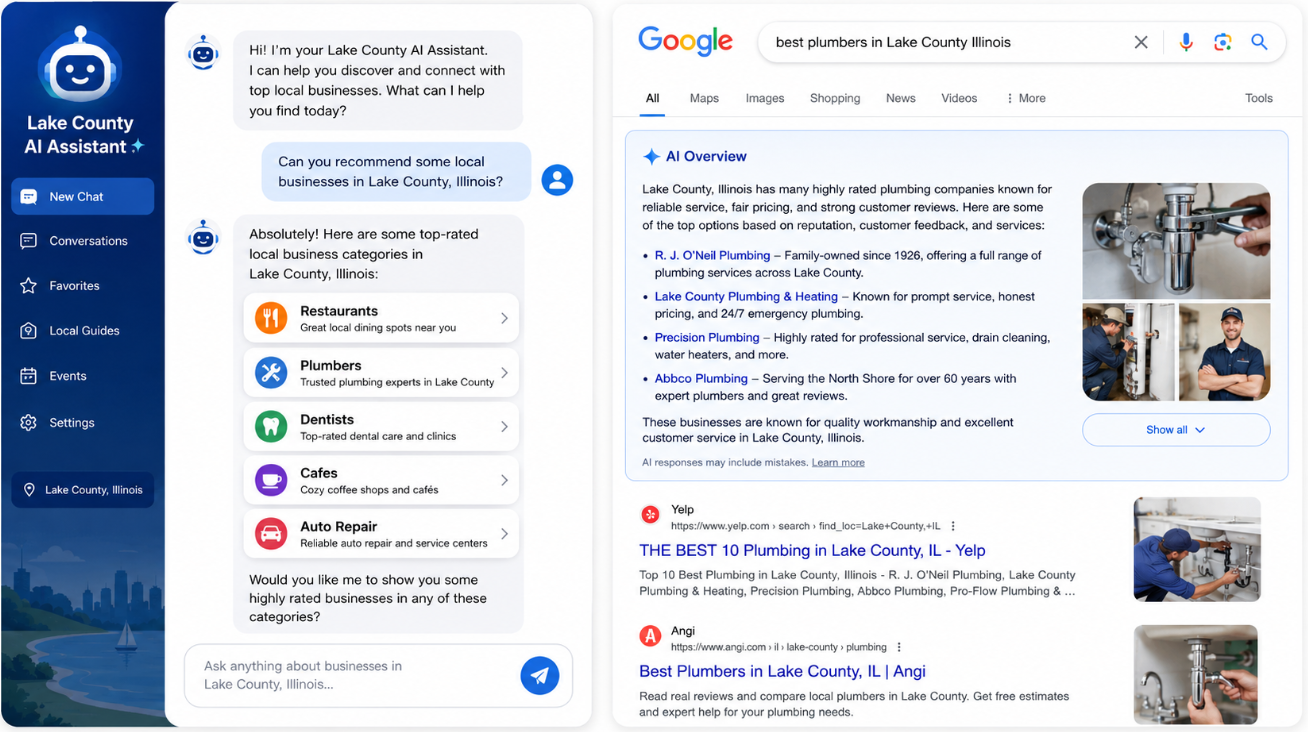
Imagine this. A homeowner in Gurnee wakes up at 2:00 AM to a burst pipe. In the past, they would grab their phone, open Google, scroll past three ads, and click the first plumber they saw.
In 2026, that same homeowner opens ChatGPT and types: “Who is the most reliable emergency plumber near me right now?”
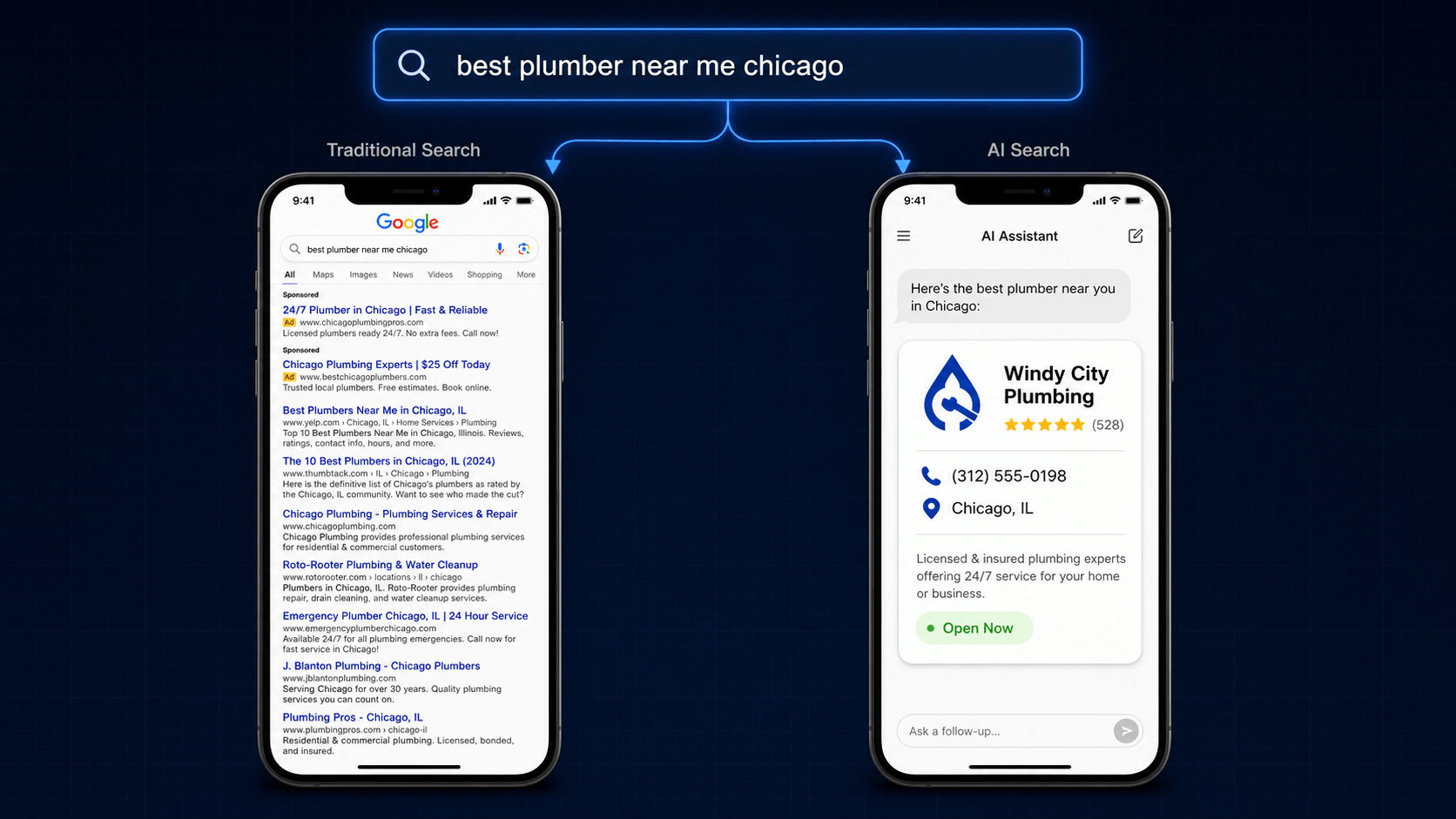
The AI does not hand them ten blue links. It gives them one direct answer: a specific business name, a phone number, and a reason to trust them. Right inside the chat window.
If that business is yours, you win the customer instantly. If it is not, you never even knew the opportunity existed.
That is the reality of search today. It is why Generative Engine Optimization (GEO) is now the most important thing a local small business can invest in. Let us break down exactly what it means, why your current website might be failing you, and how you can become the number one recommended business by AI.
What Is Generative Engine Optimization (GEO)?
Short Answer: Generative Engine Optimization (GEO) is the practice of structuring your website content and code so that AI tools like ChatGPT, Google Gemini, and Perplexity can instantly read, understand, and confidently recommend your business as the best direct answer to a user’s question.
Traditional SEO was about convincing a search algorithm to rank your link higher on a page full of other links. GEO, also known as Answer Engine Optimization (AEO), is about convincing an AI that you are the answer itself. Not a link to an answer. The answer.
AI does not care how many times you repeated your target keyword on your homepage. It cares about three things: clarity, authority, and context.
GEO vs SEO: What Is the Real Difference?
A lot of business owners ask this, and it is a completely fair question. Here is the honest side-by-side breakdown:
| Traditional SEO | Generative Engine Optimization (GEO) | |
|---|---|---|
| Goal | Rank #1 on Google | Get quoted by AI as the direct answer |
| Output | A link in search results | A direct recommendation inside AI chat |
| Key Signals | Backlinks, keywords, page speed | Clarity, schema markup, E-E-A-T, structured answers |
| User Action | Must click your link | No click needed. AI delivers your info directly. |
| Timeline | 3 to 6 months | 4 to 10 weeks for initial AI pickup |
The critical point: you still need traditional SEO. GEO does not replace it. It builds on top of it. But if you are only doing traditional SEO in 2026, you are leaving a growing slice of your potential customers completely unreachable.
Why Traditional Local SEO Is Failing Small Businesses in 2026
I talk to local business owners every single week who are frustrated. They spent thousands on a website and an SEO package two or three years ago. For a while, the phone rang. Now it is quieter and they cannot explain why.
They ask me: “Did we do something wrong?”
No. The rules of the game simply changed underneath them.
Most older websites were built for human eyes and 2019-era algorithms, not for AI crawlers operating at lightning speed. If your website is slow, stuffed with heavy plugins, or written in vague marketing language, an AI bot will scan it, find nothing useful to quote, and move on to your competitor’s cleaner site in milliseconds.
AI engines are incredibly sophisticated but they have zero patience for clutter. They reward websites that are fast, clear, and well-structured. If they cannot immediately understand what you do, who you serve, where you are located, and why you are trustworthy, you are invisible to them.
And here is the uncomfortable truth: zero-click search is accelerating. More and more people are getting their answers directly from AI without ever visiting a website. If you are not the source being quoted, you do not just lose the click. You lose the customer entirely.
How to Optimize Your Local Business for AI Search Engines
Getting ChatGPT, Gemini, or Perplexity to recommend your business comes down to four fundamental shifts in how your website is built and written.
1 Build an Answer-First Content Strategy
AI engines are designed to answer questions, so your website needs to provide direct answers before the user even finishes asking.
Look at the headings on your current website. If they say things like “Our Services” or “Welcome to Our Business,” that helps no one. Instead, structure your key pages using a clear question-and-answer format.
Think about the exact questions your customers type into their phones:
- “How much does a website cost for a small business in Chicago?”
- “What is the best way to get more customers online in 2026?”
- “Do I need Google Ads or social media for my local business?”
Under each question, write a crisp 40 to 60 word answer immediately. That is the soundbite an AI can quote directly. You can expand on the detail below it. This is exactly how this article is written, and it is why AI engines are far more likely to cite it over a competitor’s generic blog post.
2 Fix Your Slow, Bloated Website
A slow website is not just a bad user experience. It is a trust signal failure in the eyes of AI crawlers.
At Seven Seas Web Design, this is the foundation of everything we build. We see countless Chicago small businesses losing visibility because their websites are buried under unnecessary plugins, oversized images, and template code that serves no real purpose. Our fast, lightweight web design in Chicago uses hand-coded custom solutions that load in under 2 seconds, making it effortless for AI to crawl, parse, and trust your entire site instantly.
When your code is clean and your site is fast, AI categorizes you as a high-quality, reliable source. When it is not, you are filtered out before you even get a chance to compete.
3 Add Schema Markup So AI Understands You Instantly
Schema Markup, specifically JSON-LD, is invisible code in your website’s header that acts as a direct translator for AI. Humans never see it. AI reads it first.
Without schema, an AI has to guess what your business does, where you are located, what your hours are, and how customers rate you. With properly configured schema, you are explicitly telling the AI:
- “We are a local business in Chicago, Illinois.”
- “We serve customers within 25 miles of Gurnee.”
- “Our average review rating is 4.9 stars from 87 verified customers.”
- “We specialize in web design for small businesses.”
That level of clarity is exactly what gets a business quoted in an AI response. If your website does not have 2026-compliant LocalBusiness schema, you are whispering in a crowded room while your competitors have a megaphone.
4 Build E-E-A-T Signals AI Engines Trust
E-E-A-T stands for Experience, Expertise, Authoritativeness, and Trustworthiness. It is the framework AI uses to decide whether your content deserves to be recommended to someone else.
For local businesses, this means:
- Real reviews visible on your site and Google Business Profile (builds trust)
- Author bios on blog posts with genuine credentials (demonstrates expertise)
- Case studies and real client results with specific numbers (proves experience)
- Consistent Name, Address, and Phone number across all directories (establishes authority)
- HTTPS and a clear privacy policy (confirms trustworthiness)
AI does not recommend businesses it cannot verify. The more clearly your website proves that real humans trust your business, the more confidently an AI will put your name in front of new customers.
The Local Advantage: Chicago Small Businesses Can Win Right Now
Here is something most Chicago business owners do not realize: because GEO is so new, almost none of your local competitors are doing it.
They are still paying old-school agencies for outdated tactics while AI search quietly eats their traffic. That creates an enormous window of opportunity, right now, for businesses in Chicagoland to establish themselves as the default AI-recommended answer in their category.
AI engines heavily weight location signals when users ask “near me” questions. A Chicago plumber, dentist, or web design agency with a properly GEO-optimized site can outrank a national brand for local queries, because AI prioritizes the most relevant, geographically precise answer. Not the biggest company.
You do not need to compete with national corporations. You just need to be the clearest, most authoritative voice in your specific Chicago service area. Combine a strong GEO strategy with proven Google Ads and Meta Ads management and you are covering both immediate paid visibility and long-term AI search dominance at the same time.
Frequently Asked Questions About GEO for Local Business
What is the difference between GEO and SEO?
Traditional SEO gets your website listed in search results as a clickable link. GEO gets your business quoted directly by AI tools like ChatGPT and Gemini, with no click required. Both matter in 2026, but GEO is the faster-growing and least competitive channel right now for local businesses.
How long does it take to get quoted by ChatGPT?
With proper schema markup, an answer-first content structure, and strong E-E-A-T signals in place, most businesses start seeing AI citations within 4 to 10 weeks of optimization. That is significantly faster than traditional SEO, which typically takes 3 to 6 months to show real results.
Does my business need a brand new website to do GEO?
Not always. Many existing sites can be upgraded with schema markup and content restructuring. However, if your site is slow, built on a bloated template, or has not been updated in 2 to 3 years, a clean rebuild will dramatically accelerate your results and give you a lasting edge over competitors.
Which AI platforms should I optimize for first?
ChatGPT, Google Gemini, and Perplexity are the three highest-priority platforms for local business GEO in 2026. Google Gemini is especially important because it powers the AI Overviews that now appear at the very top of Google Search results. Our custom AI solutions for small business cover optimization across all three.
Is GEO only for tech companies or large businesses?
No, and this is the biggest misconception we hear. A plumber, a salon, a restaurant, a contractor. Any local business benefits from GEO. The businesses that win are the ones that act first, not the most technical ones. Early movers in any Chicago category are already claiming their position as the AI-recommended answer.
How Seven Seas Web Design Prepares You for the AI Era
Making this transition does not mean scrapping everything you have built. But it does require a strategic pivot, and a partner who understands both sides of it.
At Seven Seas Web Design, we sit at the exact intersection of high-performance web development and Generative Engine Optimization. We do not build digital brochures. We engineer modern revenue assets: websites that are fast enough for AI to trust, structured clearly enough for AI to quote, and compelling enough for real humans to convert.
Every site we build includes:
- Lightweight, hand-coded architecture that loads in under 2 seconds
- Full LocalBusiness JSON-LD schema configuration built into every page
- Answer-first content structure on all key service pages
- E-E-A-T signals built into the design and content from day one
- Ongoing optimization as AI platforms and algorithms evolve
As an independent Chicago agency focused entirely on small business growth, we have one goal: make your business the name that AI recommends when your next customer is asking for exactly what you offer.
Ready to find out how AI currently views your website?
Do not let your competitors claim the AI-recommended spot in your category first.
Get Your Free Website Audit →Published by Seven Seas Web Design. Chicago’s small business web design and digital marketing agency, proudly serving Gurnee, Lake County, and the greater Chicagoland area.