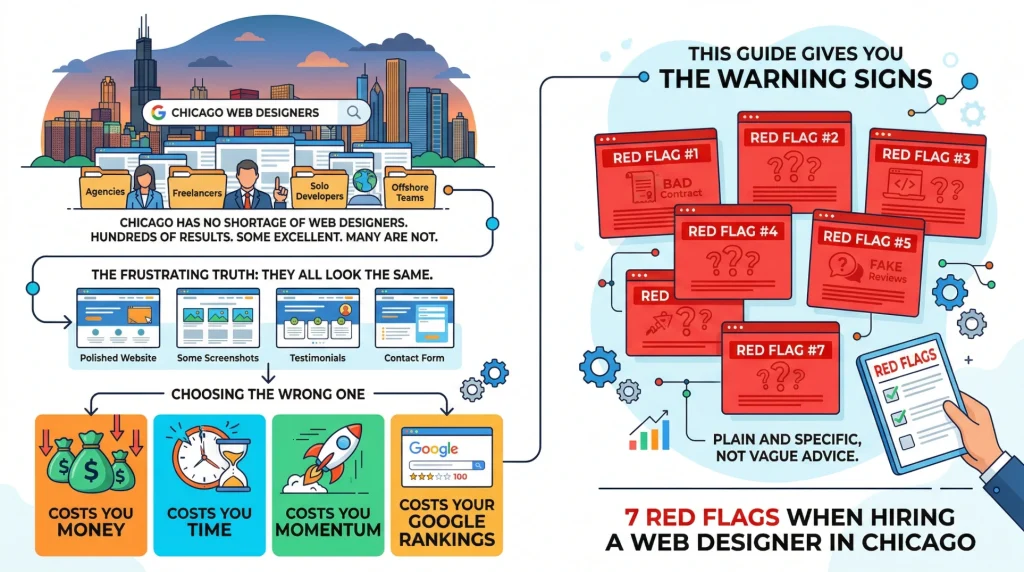
Chicago has no shortage of web designers. Type the phrase into Google and you will get hundreds of results agencies, freelancers, solo developers, offshore teams operating through Chicago-based holding pages. Some are excellent. Many are not.
The frustrating truth is that they all look the same at first glance. Polished website. Some screenshots. A handful of testimonials. A contact form. Choosing the wrong one does not just cost you money it costs you time, momentum, and in some cases your Google rankings when you eventually have to start over.
We have built and redesigned websites for Chicago businesses that came to us after exactly this experience. In every single case, the warning signs were there before they signed. They just did not know what to look for.
This guide gives you those warning signs plain and specific, not vague advice like “check their reviews.” Seven concrete red flags, what each one actually means for your project, and what to do instead.
“The goal of this article is simple: save you from the mistake that costs Chicago business owners an average of 12 to 18 months and a second budget round to fix.”
Quick-reference: all 7 red flags at a glance
| # | Red flag | What to do instead |
| 1 | No real portfolio only mockups | Ask for 3 live site URLs |
| 2 | Their own site loads slowly | Run it on PageSpeed Insights first |
| 3 | Vague ownership terms | Get “you own 100%” in writing |
| 4 | SEO not mentioned at all | Ask exactly what SEO is included |
| 5 | No clear post-launch plan | Ask what happens on day 31 |
| 6 | One-size pricing, no questions | Real agencies ask questions first |
| 7 | Disappears after first payment | Check reviews for post-launch support |
Red flag #1: Their portfolio only shows images, not live links
This is the most common warning sign and the easiest to miss because the images look great. A designer shows you ten screenshots of beautiful websites. They all look professional. But when you ask for the actual URLs the live websites you can visit and test yourself the conversation suddenly gets vague.
“That client rebranded.” “That site moved to a different platform.” “I can check if the link is still live.” These are not acceptable answers for work that is supposedly your evidence of quality.
Screenshots can be faked, AI-generated, or taken from template demos. A live website can be tested for real speed, mobile performance, and whether it actually converts. If a Chicago web designer cannot produce three live working websites they built in the last 18 months, that portfolio is not evidence it is marketing.
What to do instead: Ask for three live site URLs before any call or meeting. Load them on your phone. Check the speed, the mobile layout, and whether you can navigate without confusion. This five-minute test tells you more than an hour of conversation.
Red flag #2: Their own website is slow, broken, or outdated
This one is almost too obvious to include yet it gets overlooked constantly. Before you hire a web designer in Chicago, go to their website and load it on your phone. Use Google PageSpeed Insights (free, takes thirty seconds) to get an actual performance score.
If the agency selling you a fast, modern website scores below 70 on mobile performance for their own site, you have your answer. They either do not care about performance, do not know how to achieve it, or they built their own site years ago and have not touched it since none of which inspires confidence.
The same logic applies to design. An agency whose own site looks like it was built in 2019 is not going to build you something that feels current in 2025. The work they do on their own brand is a preview of the minimum effort you will receive.
What to do instead: Run the agency’s own website through PageSpeed Insights before your first call. A score above 85 on mobile is the floor for anyone you should seriously consider. Below that, ask them directly why their own site scores poorly the answer will be illuminating.
Red flag #3: Vague or missing terms around who owns the website
This is where Chicago businesses lose the most money not in the upfront cost, but in what happens when the relationship ends. Some agencies build your website on proprietary platforms they control. Others register your domain under their own account. Some use licensing models where, if you stop paying their monthly fee, the website effectively goes dark.
Read the contract carefully. If you see language like “hosted exclusively on our platform,” “license to use the design,” or “domain managed by agency,” those are warnings. You should own your domain, your hosting account, your codebase, and every piece of content on your website unconditionally, from the day the project is complete.
At Seven Seas Web Design, ownership is non-negotiable. Every client receives full source code, domain access, and hosting credentials. No lock-in, no conditions. We believe you should be able to walk away from any agency including us and not lose your digital asset.
What to do instead: Before signing, ask in plain terms: “If we stop working together after the project, do I own 100% of the website, domain, and code?” If the answer is anything other than a clear yes, ask them to put that language in writing. If they won’t, walk away.
Red flag #4: Nobody mentions SEO until you ask
A website that does not rank is a digital pamphlet. It exists, it looks nice, and almost nobody sees it. Yet a surprisingly large number of Chicago web designers will build you a full website from start to finish without once mentioning search engine optimisation not because they forgot, but because they simply do not build with it in mind.
Real SEO for Chicago businesses starts at the foundation level, not as an afterthought: page title structures, heading hierarchy, schema markup, Core Web Vitals, image alt tags, internal linking, and local signals like your address and service area. None of this takes extra time when done during the build. All of it takes significant effort and money to retrofit after the fact.
If you are three calls into conversations with a web designer in Chicago and the word “SEO” has not come up once, that is a gap in their process, not something you should have to ask for.
What to do instead: Ask specifically: “What SEO is included in the build by default?” A strong answer covers page titles, meta descriptions, heading structure, schema markup, Core Web Vitals, and a Google Search Console setup. A weak answer is “we can add an SEO package for an extra fee.”
Red flag #5: No clear plan for what happens after launch
The launch is not the end of the project it is the beginning of the work. In the first 30 days after a website goes live, a serious agency monitors crawl errors in Google Search Console, verifies that all tracking is firing correctly, checks Core Web Vitals across devices, and confirms that the contact forms and conversion paths are working as intended.
A surprisingly large number of Chicago web designers hand over a finished website and consider the job done. Then you discover three weeks later that your contact form was sending submissions to a test email address, or that Google cannot crawl a key page because of a robots.txt error that nobody checked.
Ask every agency you speak to: “What does your post-launch process look like?” If the answer is “we hand you login details and you’re good to go,” that is not a support structure that is an exit. Ongoing website maintenance is not optional for a site you intend to grow.
What to do instead: Ask for a written post-launch checklist and confirm that at minimum it includes Google Search Console setup, 30-day crawl review, analytics verification, form testing, and a 30-day check-in call. If they cannot produce a checklist, they probably do not have one.
Red flag #6: They quote a price before asking a single question
This one surprises people. Surely a fast quote is efficient? No it is a warning that the agency is selling a package, not solving your problem.
A web designer in Chicago who quotes you within five minutes of first contact without asking about your industry, your existing traffic, your target customer, your competitors, your current conversion rate, or what a successful website looks like for your specific business is not designing for you. They are slotting you into a template they have already built twenty times.
Real custom web design starts with questions. What are you trying to achieve? Who is your customer? What do they need to see before they trust you enough to contact you? What are your competitors doing well and doing poorly? What are the three things about your business that no competitor can honestly say?
These are not time-wasting questions they are the difference between a website that generates leads and one that simply exists.
What to do instead: If you receive a quote before a discovery call, treat it as a red flag. Push back and ask for a strategy conversation first. Any agency worth hiring will welcome the opportunity to understand your business before they propose a price.
Red flag #7: Reviews mention great design but nothing about results
This is subtle but important. Read the testimonials on a web designer’s website but read them critically. Reviews that say “beautiful website,” “great to work with,” and “delivered on time” tell you nothing about whether the work actually performed.
Now look for reviews that say things like “our leads doubled in three months,” “we rank on page one for our main keyword,” “the new site converted 40% better than the old one,” or “we saw a measurable increase in traffic within six weeks.” These are outcome reviews they tell you the agency cares about and tracks what happens after launch.
The absence of outcome reviews in a Chicago web designer’s testimonials does not mean their clients had bad results. It might mean they simply never asked, never tracked, or never thought to follow up. But in a competitive market where every agency claims to be results-driven, the ones who can show actual results stand apart from those who only show deliverables.
What to do instead:
“Beautiful design that nobody finds is a waste of your budget. The right web designer in Chicago builds you something that ranks, converts, and grows not just something that looks good in a screenshot.”
One bonus question to ask every Chicago web designer
Beyond the seven red flags above, there is one question that cuts through almost every sales conversation and reveals what an agency actually prioritises. Ask them:
“If my website goes live and I get no new enquiries in the first 60 days, what happens next?”
A transactional agency will tell you the website is complete and performance is outside their scope. A genuine partner will walk you through a diagnostic process checking traffic data, reviewing search rankings, testing conversion paths, and proposing specific improvements based on what the data shows.
That difference between an agency that hands over a finished product and one that cares about your growth is the most important thing to identify before you sign. Our team at Seven Seas Web Design is based at 1 E Erie St in Chicago IL and works exclusively with businesses that want results, not just a website.
Ready to work with a Chicago web designer who checks none of these boxes?
If you want a straight conversation about your website what is working, what is not, and what a properly built site could do for your business reach out to us directly. We offer free strategy calls for Chicago businesses with no pressure and no pitch.
Call (630) 202-8781, email info@sevenseaswebdesign.com, or explore our web design services for Chicago, SEO, social media marketing, e-commerce, and app development — all from one team, one address, and one accountable partner.