
If you run a business in Chicago, you already know how hard it is to get a customer’s attention. Whether you operate a dental clinic in Lincoln Park, a law firm in the Loop, or a roofing company servicing Gurnee and the greater Chicagoland area, the competition is constantly growing.
Ten years ago, having a website was enough. It was essentially a digital business card. You put your phone number, a few pictures, and your address online, and people found you. In 2026, that strategy is completely dead.
Today, your website is your primary salesperson. It works 24 hours a day, 7 days a week. But if it is slow, confusing, or hidden on page four of Google search results, it is a salesperson who never shows up to work. At Seven Seas Web Design, we audit hundreds of websites for local businesses, and the mistakes are almost always the same. Business owners spend thousands of dollars on beautiful designs that Google cannot read, or they buy cheap templates that load so slowly the customer leaves before seeing a single word.
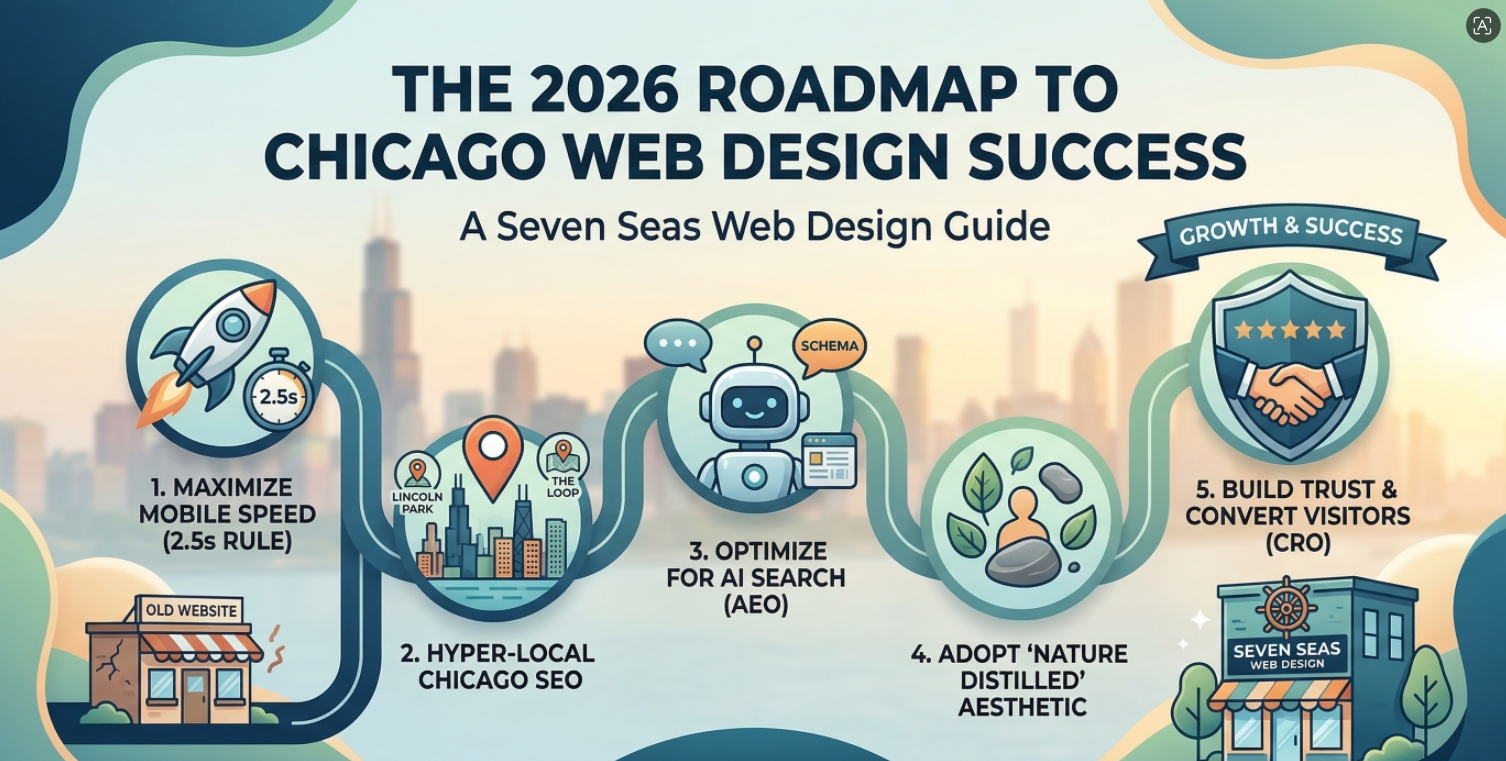
In this comprehensive guide, we are going to walk you through exactly what a Chicago business needs to build a website that not only looks professional but actually ranks on Google and generates real revenue. We will cover the technical requirements of speed, the new rules of local SEO, how to design for trust, and how to adapt to the new reality of Artificial Intelligence in search.
Part 1: Website Speed and Technical Performance
Let us start with the most critical factor: Speed. You can have the best service in Chicago and the most beautifully written content, but if your website takes more than three seconds to load, you will lose the customer.
Why Google Punishes Slow Websites
Google’s primary goal is to give its users a good experience. If Google sends a user to your website and your website takes five seconds to load, the user gets frustrated. They hit the “back” button. Google tracks this. If it happens enough, Google decides your website is a bad recommendation and drops your ranking.
Google measures this using a system called Core Web Vitals. These are strict metrics that test exactly how your page loads. The most important one is called Largest Contentful Paint (LCP). This measures how long it takes for the biggest piece of content on your screen—usually a banner image or a headline—to become fully visible. In 2026, your LCP must be under 2.5 seconds.
What Slows Down a Chicago Business Website?
When we take over a project at Seven Seas Web Design, we usually find three main culprits causing slow speeds:
- Massive Image Files: The number one reason websites load slowly is that the owner uploaded raw, uncompressed photos directly from a camera or phone. Every image on your site must be compressed and converted to modern formats like WebP. WebP images look perfectly clear but take up a fraction of the file size. You can test your current image load times and overall speed using Google PageSpeed Insights.
- Cheap Shared Hosting: You get what you pay for with website hosting. If you are paying $3 a month for hosting, your website is sitting on a server with thousands of other websites. Local businesses need dedicated or high-quality cloud hosting. Ideally, your server should be physically located near the Midwest to ensure data travels the shortest distance possible to your Chicago customers.
- Heavy Code and Plugins: Many business owners build their sites using DIY builders and add a new “plugin” for every feature they want. Every plugin adds heavy, bulky code to your site. A professional agency writes clean, custom code that does exactly what you need without the unnecessary weight.
Part 2: Mastering Local SEO and Keyword Clusters
Ranking nationwide for “Best Plumber” is nearly impossible and a waste of money. You do not need customers in California; you need customers in Chicago. This is where Local SEO and Keyword Clustering come into play.
The Shift from Single Keywords to Clusters
In the past, SEO agencies would pick one keyword, like “Chicago Web Design,” and stuff it into a page fifty times. Google’s algorithm is much smarter now. It understands context. Instead of single words, Google looks for “Keyword Clusters”—groups of related terms that prove you are an expert in your specific location and industry.
If you want to dominate local search, your website needs to naturally include a wide variety of terms that signal your exact service area.
Example of a Strong Keyword Cluster for a Chicago Business:
- Primary Service Keyword: Web design agency Chicago
- Secondary Service Keywords: Custom WordPress development, small business SEO services, website redesign
- Hyper-Local Keywords: Web developers in the Loop, SEO company near River North, digital marketing for Gurnee businesses
- Question-Based Keywords: How much does a website cost in Chicago? Best local web designers near me.
By writing complete, helpful pages that include these clusters naturally, you tell Google exactly who you are and who you serve.
The Power of the Google Business Profile (GBP)
Your website is only half of your local SEO strategy. The other half is your Google Business Profile (formerly Google My Business). When someone searches “roofer near me” on their phone, the first thing they see is the “Map Pack”—the three local businesses displayed on a map with their star ratings.
Getting into that top three is the most profitable thing a local business can do. To get there, your website and your GBP must work together.
- Consistent Information: Your Name, Address, and Phone Number (NAP) must be identical on your website, your Google Profile, and any local directories like Yelp or the Better Business Bureau.
- Local Landing Pages: If you serve multiple areas, you need a specific page on your site for each area. If you are based in the city but serve the suburbs, create a dedicated page for those areas to talk about their specific needs. If you need help structuring these location pages properly, our Seven Seas Web Design SEO Services team can build out a local ranking strategy for you.
Part 3: Answer Engine Optimization (AEO)
You cannot talk about SEO in 2026 without talking about Artificial Intelligence. Search is changing. People are no longer just typing incomplete sentences into Google. They are speaking complete questions into their phones, or they are using AI tools like ChatGPT, Perplexity, and Google’s AI Overviews to get instant answers.
This means you must optimize your website to be read by Answer Engines, not just Search Engines. This practice is called Answer Engine Optimization (AEO).
How to Write for AI
AI models look for clear, direct facts. They do not understand sarcasm, and they hate marketing fluff. If your website says, “We provide synergistic digital paradigms,” the AI will ignore you. If your website says, “We design custom websites for small businesses in Chicago, starting at $3,000,” the AI understands exactly what you do.
To win at AEO, your website must answer the exact questions your customers are asking. Every service page should have a Frequently Asked Questions (FAQ) section at the bottom.
Examples of clear AEO questions and answers:
- Question: How long does it take to build a website?
- Answer: At Seven Seas Web Design, a standard 5-page small business website takes 4 to 6 weeks to design, develop, and launch.
- Question: Do you provide ongoing maintenance?
- Answer: Yes, we offer monthly maintenance packages that include security updates, backups, and content changes.
Schema Markup: The Hidden Language of AI
To make it even easier for Google and AI to understand your business, we use something called Schema Markup. This is a special type of code hidden in the background of your website. Your human visitors never see it, but search engines read it instantly.
Schema tells the search engine: “This string of numbers is a phone number. This block of text is a customer review. This address is located in Chicago.” Sites with proper Schema Markup are far more likely to be recommended by AI assistants when users ask for local recommendations.
Part 4: Designing for Trust and Conversion (CRO)
Getting traffic to your website is only step one. If 1,000 people visit your site and nobody calls you, the website has failed. Converting a visitor into a paying customer requires specific design choices. This is called Conversion Rate Optimization (CRO).
The Three-Second Test
When a user lands on your homepage, they must be able to answer three questions within three seconds:
- What do you do?
- Where do you do it?
- How do I contact you?
If your header image is just a generic picture of the Chicago skyline with the text “Welcome to our website,” you are failing the test. Instead, your headline should be direct: “Reliable Accounting Services for Small Businesses in Downtown Chicago.”
Below that headline, there should be a clear Call to Action (CTA) button. Do not use passive words like “Submit” or “Learn More.” Use action-oriented words like “Get a Free Quote,” “Book an Appointment,” or “Call Us Today.”
Building E-E-A-T (Experience, Expertise, Authoritativeness, Trustworthiness)
Google wants to send its users to safe, reliable businesses. They measure this using the E-E-A-T framework. You must prove you are a real expert.
How do you do this through design?
- Real Photography: Stop using stock photos of actors shaking hands in a glass boardroom. Customers know they are fake. Use real photos of your team, your office, your trucks, or your actual work. Real photos build immediate trust.
- Detailed Case Studies: Do not just list your services; show your results. Write a short page explaining a problem a past client had, the exact steps you took to fix it, and the final result.
- Verified Reviews: Embed your actual Google reviews directly onto your website. Do not just type them out; use a widget that pulls them straight from Google so users know they are authentic.
- Trust Badges: Display logos of your professional associations, local chambers of commerce (like the Chicagoland Chamber of Commerce), or security certificates.
Part 5: The Mobile-First Mandate
Over 65% of all local searches in Chicago happen on a mobile device. Someone is sitting on the L train, walking down Michigan Avenue, or waiting in a coffee shop, searching for a business on their phone.
Because of this, Google operates on “Mobile-First Indexing.” This means Google entirely ignores the desktop version of your website when deciding how to rank you. It only looks at your mobile site.
What Makes a Good Mobile Site?
A good mobile site is not just a smaller version of your desktop site. It requires entirely different design rules.
- Thumb-Friendly Design: All important buttons (like your phone number or contact button) must be easy to reach with a thumb while holding the phone in one hand.
- Click-to-Call Functionality: Your phone number should never just be plain text. It must be a link. When a user taps your phone number, it should immediately open their phone’s dialer.
- No Pop-Ups: Google actively penalizes sites that use full-screen pop-ups on mobile devices because they ruin the user experience. If you use lead-capture forms, they need to slide in gently or sit at the bottom of the screen.
Conclusion: Stop Losing Money to Bad Web Design
In 2026, a website is an investment, not an expense. If your current website is slow, hard to read on a phone, or invisible on Google, you are actively handing your customers over to your competitors in Chicago.
Fixing this does not mean you have to learn how to code or spend your weekends writing blog posts. It means partnering with a local expert who understands both the technical side of Google and the business side of the Chicago market.
At Seven Seas Web Design, we build high-speed, custom websites designed with one specific goal: to make your phone ring. We do not use fluff, we do not use cheap templates, and we do not guess. We use data, clean code, and proven SEO strategies to put your business in front of the people who are already looking for you.
If you are tired of a website that does nothing but cost you money, it is time to upgrade to a platform that actually works for you.
Ready to see how a professional website can transform your lead generation?